

-
Bulletin 4272 - Growing bananas in Carnarvon
Terry Hill
The banana industry in Carnarvon began with small plantings. plantings in the 1940s. Since that time the industry has grown and become the mainstay of the region's horticulture industry.
In 1991, there were 360 ha planted to bananas and the industry was valued at $18.2 ... Read more
-
Bulletin 4256 - Pecan nut cultivation
Aldo Labrosciano
Pecans Carya illinoensis, an indigenous species to Northern America, are successfully grown between the latitudes of 25° and 35°. There is considerable variation in size and flavour of the 1000 or more varieties of the nuts.
Large scale production is concentrated in north America, Israel ... Read more
-
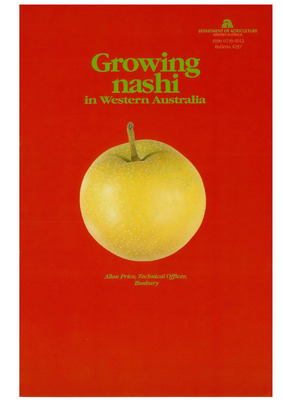
Bulletin No 4237 - Growing nashi in Western Australia
Allan Price
Nashi is the Japanese word for Pear. It is used in this context to describe pears of Asian origins, developed from Pyrus pyrtfolia as distinct from European pears (Pyrus communis).
Nashi have originated from two major areas, Japan and Korea/China.
-
Bulletin No 4146 - Commercial production of pawpaws in Western Australia
J. R. Burt and B. L. Toohill
The papaw (Carica papaya L.) is a native plant of Central America. It produces its highest yields of good quality fruit in tropical regions.
The tree is short-lived and rarely produces crops for more than two or three years. It is quick growing and soon ... Read more
-

The commercial production of musk melons
Neil Delroy and Harry Gratte
This research publication covers commercial production of musk melons, Cucumis melo L., that belong to the cucurbit family. The must melon group includes rock melons (cantaloupes), honey dew melons, Japanese musk melons, hami melons and a number of other types of musk melon.
-

Facing a drought
J A C Smith
This booklet is aimed at helping you decide on strategies, in this and future droughts, in relation to money flow, animal management and cropping. It highlights the technical problems associated with different strategies and how to combat them.
-

Virus, viroid, mycoplasma and rickettsial diseases of plants in Western Australia
L K. Price and George McLean
Provides details of the virus, viroid, mycoplasma and rickettsial diseases recorded on plants in Western Australia. To establish these records, a range of tests have been used including sap transmission; leaf dip electron microscopy; aphid transmission and serology. The authenticity for each record is noted ... Read more
-
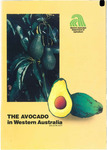
Bulletin No 4077 - The Avocado in Western Australia
M. G. Hawson and Jacqui Davis
The avocado, Persea americana, is a member of the laurel family, and a close relative of the common shade tree, camphor laurel. It is native to Mexico, Central America, West Indies and nearby areas where the fruit was often a major part of the diet ... Read more
-
Fluoride toxicity in grape vines : a case study
Walter Jacob Cox and L T. Jones
The onset of visual damage varied with the season. The symptoms consisted of marginal and tip necrosis in the early stages with the necrotic areas gradually expanding between the veins. In severe cases the leaves shed. Old leaves were affected first although foliage of any ... Read more
-
Effect of dusts on tomato production
Walter Jacob Cox, L T. Jones, and Dennis R. Phillips
The phytotoxicity of bauxite, cement flue, mud lake, alumina and kaolin dusts were examined on tomatoes. Mud lake white dust caused severe leaf scorch, affected plant growth and resulted in no harvestable yield. Flue dust applied daily depressed market yield of fruit from 64 t ... Read more
-
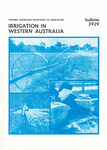
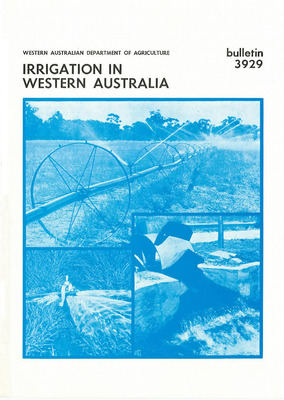
Bulletin 3929 - Irrigation in Western Australia
K S. Cole
Irrigation is essential in many parts of the world to produce essential food and profitable cash crops. Generally, those areas of land with less than 360 mm of rain spread over a distinct wet season of several months cannot grow crops for food or cash ... Read more
-
A report on erosion and range condition in the West Kimberley area of Western Australia
A L. Payne, A Kubicki, D G. Wilcox, and L C. Short
Nearly 30 per cent (26 700 sq. kilometres) of the West Kimberley survey area is in bad range condition. Nearly 51 per cent (45 400 sq. kilometres) of the area is in fair range condition. Nearly 20 per cent (17 500 sq. kilometres) of the ... Read more
-

Bulletin no 3994 - Kikuyu grass : establishment, management and utilisation in the south west.
R. Sprivulis
Kikuyu grass (Pennisetum clandestinum), kikuyu for short, is a summer growing turf-forming perennial. In the absence of winter frosts and with sufficient summer moisture it remains green all year round. It is a vigorous and aggressive grass spreading by means of prostrate above and below ... Read more
-

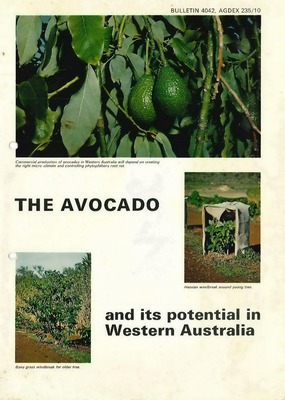
The Avocado and its potential in Western Australia
M G. Hawson
This bulletin summarises the background of the avocado and its requirements for growth and production of fruit in Western Australia, and considers its economic potential.
-

Bulletin No 4007 - Grasses in South Western Australia
J G. Paterson
IThe grasses comprise one of the world's largest families of flowering plants, with over 500 groups or genera containing well over 5000 individual types or species distributed throughout the world. About 125 groups have been recorded in Western Australia but it is probable that the ... Read more
-

Bulletin 4002 - Trickle irrigation for farms
K Cole
The continued demand for, and use of trickle irrigation is proof of the inherent potential and performance of this form of irrigation.
Originally it was used in glasshouses and nurseries but it is now widely adapted to orchards, vegetable and other horticultural small crops and ... Read more
-

Fruit in W.A.
Department of Agriculture and Food, Western Australia
The main fruit growing districts of Western Australia are in the Mediterranean climate areas of the south-west. Apples, pears, stonefruit, citrus and vines are grown on a commercial basis. Figs, mulberries and olives are also grown, but not in big commercial quantities.
-

Bulletin 3933 - Trickle irrigation for home gardens
K Cole
The use of trickle irrigation in the home garden can save money, time and water.
Trickle irrigation is a concept first used in glasshouses in England, then applied to field crops in Israel and developed and refined in Australia and America. Today it is widely ... Read more
-
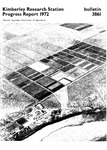
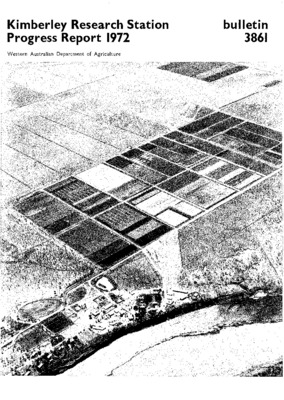
Bulletin No 3861 - Kimberley Research Station - Progress report 1972
J. R. McAlpine, R. H. Gunn, P. Jakobsen, R. Wetselaar, J. J. Basinski, N. J. Thomson, A. G. L. Wilson, D. H. Mackenzie, A. J. Millington, D. F. Beech, P. C. Owen, B. G. Williams, C. G. Blunt, and A. McR Holm
The systematic investigations of the potential of the Ord area for irrigated farming began during the Second World War when the possibilities of damming the river were first examined, initial soil survey was carried out, and agricultural experiments started. The Kimberley Research Station was established ... Read more
-

Commercial production of tomatoes in Western Australia
J P. Fallon and W H. Kooyman
The tomato crop is subject to many hazards. Pests, diseases and adverse environmental conditions are frequently encountered and must be overcome. This bulletin has been prepared to give growers, whether they be experienced or new to tomato culture, an outline of the more important cultural ... Read more
-

Bulletin No 3768 - Submitting plants for disease identification
M D. Marcley
THERE are several important points to remember when submitting plant material for disease identification by the Department of Agriculture's Plant Pathology Branch.
Firstly it is very important to collect a suitable sample because it is very difficult to determine the cause of a plant disease ... Read more
-
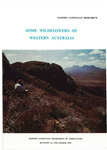
Some wildflowers of Western Australia
C. F. H. Jenkins and A. S. George
MUCH recent discussion on conservation has centred around the importance of wild flower reserves and the need for protecting one of thci State's most important tourist attractions. Although less important to visitors than the flowers, many of our wild animals hold equal interest for nature ... Read more
-
Bulletin No 3547 - Kimberley Research Station - Progress report 1968
Western Australian Department of Agriculture
Rivers flowing to the Gulf of Carpentaria and the Timor Sea have been estimated by hydrologists to carry about three times the water transported annually over the Murray drainage system and the South Eastern slopes which, together, comprise the highly settled agricultural areas of South ... Read more
Printing is not supported at the primary Gallery Thumbnail page. Please first navigate to a specific Image before printing.