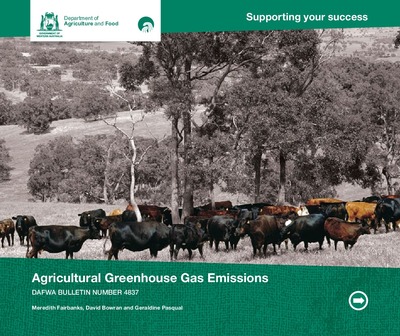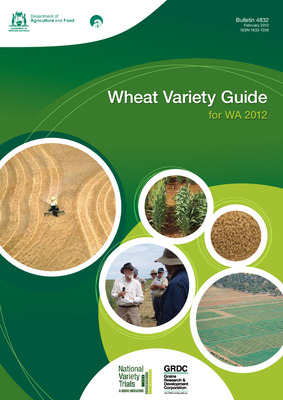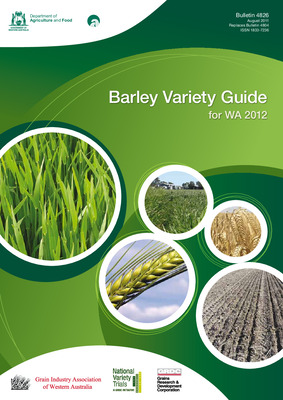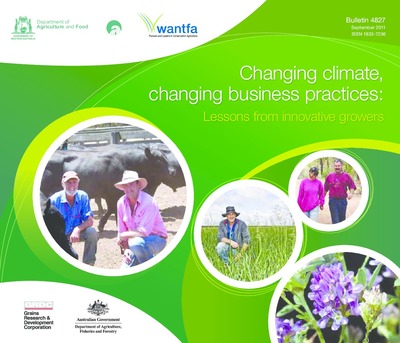


Works in this collection were published by the Department of Agriculture and Food, Western Australia.
-
Bulletin 4426 - Carrots from Western Australia - at a glance
Allan McKay and Geraldine Pasqual
Western Australia produces a wide range of horticultural commodities including fruit, vegetables, flowers, nursery products and wine as part of its fast growing $400 million horticultural industry. Natural advantages such as the mild climate and clean environment, suitable soils and water make Western Australia an ... Read more
-
Bulletin 4430 - Growing bulb onions in Western Australia
John Burt
The bulb onion (Allium cepa var. cepa), together with chives, garlic, leeks, shallots and spring onions are members of the Amaryllidaceae family. The origins of the plant are from the Middle East, where it grew in an arid climate and on shallow, stony soils. Onions ... Read more
-
Bulletin 4435 - Exotic diseases - Pigs
Agriculture Western Australia
An exotic disease is a disease that is not present in Australia.
If an exotic disease did occur in Australia it would cause production losses, stock deaths and stop exports of primary production. When export markets are lost they can only be re-established once it ... Read more
-
Bulletin 4446 - Ord Land and Water Management Plan 2000
Agriculture Western Australia and Community of Kununurra
The wise use of the land and water of the Ord has become an imperative driven by increasing awareness of the impacts of current uses on ground water and the on the quality of the Ord River itself.
We have been lucky as a community ... Read more
-
Bulletin No 4315 - Western Australia's Agricultural, Food & Fisheries industries 1999 - 2000
Besko Trhuij and Francis D'Emden
Fifth Edition (revised and updated) December 2000.
Western Australia’s agriculture and fisheries industries have an international reputation for providing premium quality food and fibre produce to customers around the world.
The State of Western Australia is setting the international quality standard in the production of ... Read more
-
Catchment Water Management: Guidelines for those considering drainage for waterlogging and salinity management
Department of Agriculture and Food, Western Australia; Water and Rivers Commission; and State Salinity Council
Landholder groups and government agencies are continuing to develop "best drainage practice" guidelines and these will increase our knowledge of drainage, and deep drainage in particular, as a management tool. The brochure does not provide all the answers, but is intended to provide some basic ... Read more
-
Dealing with a dry season
Department of Agriculture and Food, Western Australia
Farmers' approaches to adverse seasonal conditions whether they be frost, flood or low rainfall should be to acquire as much information as possible on the immediate agronomic and financial situations and make a judgement on the longer term implications for the following seasons. Once the ... Read more
-
Environmental guidelines for new and existing piggeries
A Latto, John Noonan, and R. J. Taylor
These guidelines apply to the management of Western Australia piggeries in Western Australia, including intensive Growing pigs under intensive conditions where the and extensive operations, straw-based housing and animals spend their entire life cycle indoors, is an combinations of these (otherwise referred to as semi- ... Read more
-
Fertilisers for wine grapes : an information package to promote efficient fertiliser practices
B. H. Goldspink, Neil Lantzke, Bob Paulin, Diana Louise Fisher, Colin Gordon, N. Cross, and J M. Campbell-Clause
-
Growing lavender in Western Australia
Aileen Reid
Lavender oil is an essential oil, derived from plants (genus Lavendulai primarily by steam distillation of the flowers. There are several types of lavender oil. The 'true' lavender oil, and the most highly prized, comes from Lavendula augustifolia; it is primarily used in the fragrance ... Read more
-
Mango growing in Western Australia
P R. Johnson and D C. Parr
This bulletin covers mango growing in Western Australia in Kununurra, Carnarvon, Kimberly, Gingin, Perth regions. Details include climate requirements, soils, propagation, planting, spacing, weed control, nutrition, pests, diseases and disorders, pruning, harvesting and packing, ripening and storage, and processing.
-
Profitable canola production in the south coastal region 2000
David Eksteen
Why grow canola in the South Coast Region? Canola is a member of the Brassicaceae family, which also includes mustard, turnip, wild radish, cauliflower, cabbage and broccoli. It is a winter growing oilseed that can be produced in most arable areas of Australia where winter ... Read more
-
Pulse and canola frost identification:the back pocket guide
Craig White
This field guide will help you identify the common symptoms of frost damage in pulse and canola crops. It also contains pictures of other plant symptoms often confused with frost damage in these crops.
Frost damage reduces crop yield and grain quality. Early identification of ... Read more
-
The Wheat book : principles and practice
W K. Anderson and J R. Garlinge
Contents : Environment / revised by J. Cramb, J. Courtney and P. Tille - The structure and development of the cereal plant / revised by T.L. Setter and G. Carlton - Germination, vegetative and reproductive growth / revised by T.L. Setter and G. Carlton - ... Read more
-
Western Australia soil acidity research and development update 2000 : time to lime
Department of Agriculture and Food, Western Australia
We have come a long way over the past three or four years in terms of both, the level of understanding and recognition of Soil Acidity as a major land degradation issue for the wheatbelt of Western Australia, and, in our actions to treat the ... Read more
-
An assessment of the efficacy of deep drains constructed in the wheatbelt of Western Australia Part 1 A discussion on drainage implmentation in the wheatbelt : a case study review, summary, conclusions and recommendations
N A. Coles, Richard J. George Dr, and A D. Bathgate
Australia has undertaken a strategic review of current and historical deep drainage projects. A 'rapid appraisal' methodology was utilised, based principally on existing hydrological investigations and interpretation and anecdotal evidence provided by landholders to clarify the role of drainage in managing water in dry land ... Read more
-
Bulletin 4357 - Fertilisers for pastures on sandy soils of the Swan Coastal Plain
K. W. Angell
When newly cleared for agriculture, the sandy soils of the Swan Coastal Plain were acutely deficient in phosphorus (P), nitrogen (N), and the trace elements copper ( Cu) and zinc (Zn) and sometimes molybdenum (Mo). Phosphorus deficiency was overcome by applying single superphosphate. Trace element ... Read more
-
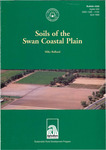
Bulletin 4359 - Soils of the Swan Coastal Plain
Mike Bolland
Almost all the soils of the Swan coastal plain are formed by material deposited by sea, rivers and wind. The Yilgarn Block, east and south of the Scarp bordering the Swan Coastal Plain (Fig. 1), rose about 40 to 50 million years ago. This caused ... Read more
-
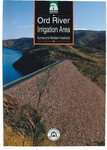
Bulletin 4369 - Ord River Irrigation Area - Kununurra Western Australia
Agriculture Western Australia
The Ord River Irrigation Area (ORIA) in the Kimberley Province of Western Australia is the product of a bold and imaginative plan to develop part of the nation's tropical north for intensive agriculture by harnessing the waters of the Ord River. The principal features of ... Read more
-
Bulletin 4371 - Growing bamboo in Western Australia
Bob Gretton and John Burt
Bamboo belongs to the subfamily Bambusoidae, a tribe of the Poaceae or grass family. They include 45 genera and over 1000 species. Many bamboo have edible shoots. The culms (stems) are fast growing, strong, light and useful as timber. These characteristics make the bamboo family ... Read more
-
Bulletin 4384 - New Asian vegetables from Western Australia - at a glance
Vynka McVeigh, Soon Chye Tan Dr, and Geraldine Pasqual
Western Australia produces a range of horticultural commodities including fruit, vegetables, flowers, nursery products and wine as part of its fast growing $400 million horticultural industry. Natural advantages such as climate and clean environment, soils and water make Western Australia an ideal place to supply ... Read more
-
Bulletin 4385 - Control of Mediterranean fruit fly (Medfly) in commercial orchards
Sonya Broughton and Francis De Lima
The Mediterranean fruit fly (Medfly) is thought to originate from tropical Africa. It is a pest in many areas of the world including Western Australia. It was first detected at Claremont in 1895 and is now found as far south as Esperance and as far ... Read more
-
Bulletin 4387 - Women in agriculture in Western Australia 1999
Agriculture Western Australia
WESTERN Australian women in agriculture contribute huge economic, social and community benefits to industry, to the rural sector, and to the State overall. That this contribution is not fully acknowledged, is perhaps due to the lack of clear data; many economic or social measures do ... Read more
-
Bulletin 4396 - Byenup Hill Focus Catchment Benefit: Cost analysis
Allan Herbert
The main text of this document concentrates on the costs of the proposed strategies, and the on-farm financial benefits from forecast production changes - in particular the production differences between the 'do nothing' and 'with strategy' scenarios.
Members of the catchment group indicated however that ... Read more
-
Bulletin 4397 - Stone fruit from Western Australia - at a glance
Glynn Ward, Geraldine Pasqual, and Eleanor Melvin-Carter
Western Australia produces a range of horticultural commodities including fruit, vegetables, flowers, nursery products and wine as part of its fast growing $400 million horticultural industry. Natural advantages such as climate and clean environment, soils and water make Western Australia an ideal place to supply ... Read more