

-

Processing results of Western Australian wool
John Stanton A/Prof, Lindy Coss, and Peter Metcalf
Despite a perception by some that Western Australian wool "processes poorly", this study found that consignments processed : 1) into long tops suited for worsted weaving 2) into longer than predicted tops 3) with the same consistency as other Australian consignments.
-
Goats - nutrition and feeding
Andrew C. Dunlop
The nutritional needs of goats are similar to those of sheep. They both require energy, protein, vitamins, minerals and water to survive and be productive. For optimum performance these nutrients should be supplied constantly and in relatively fixed proportions. An excess of protein, vitamins or ... Read more
-
Bulletin 4270 - Meat quality in beef cattle
Brian McIntyre
Meat quality is the sole concern of the consumer once the product reaches the supermarket shelf. Breeding, feeding or any other factors that may have been important to the beef producer have no influence over the buyer's choice. Meat quality can be divided into two ... Read more
-
Bulletin 4274 - Tree planting on the high rainfall coastal plain
Don Bennett and Richard George
Careful planning can mean the difference between the success or failure of a tree planting program . Healthy , well-e stablished trees stand a better chance of survival, grow faster and are more resistant to insect attack. The need for time-consuming watering in summer is ... Read more
-
Bulletin No 4131- Electric fencing
Dean Maughan
Fencing has always been an integral part of our agricultural system. We need fences for stock control and pasture management. Traditionally, fences have been strong and robust physical barriers. The strength and height of the fence kept domestic animals confined. For many years, conventional fences ... Read more
-
Sheep and cattle disorders reported at abattoirs
Michael Paton Dr
Meat inspectors at abattoirs record a lot of information about diseases and disorders of sheep and cattle. This information is mentioned briefly in stock health reports that are sent to producers who consign animals to Robb Jetty or E.G. Green abattoirs.
Department of Agriculture veterinarians ... Read more
-
Bulletin No 4189 - Training and care of the sheep-dog
John Charlick and Department of Agriculture, Western Australia
A well trained sheep-dog is a considerable asset to a farmer — in a recent Queensland Department of Primary Industries study, participating graziers estimated the value of a good working dog to be up to $20,000 a year.
Despite their value, dogs can be maintained ... Read more
-
Selecting and developing reliable bore sites in the eastern wheatbelt
Richard George
In the Western Australian wheatbelt, groundwater supplies contribute about 40 per cent of the on-farm livestock requirements and occasionally domestic water supply systems. The first part of this Bulletin comments on sites suitable for both high yielding bores and also those which yield water suitable ... Read more
-
Bulletin No 4225 - Dairying in Western Australia
Dean Maughan
Dairying in Western Australia is a small though very efficient industry. In 1989/90, 480 dairy farmers produced 266 million litres of milk for an estimated return of $84 million. The retail value of milk and dairy products was estimated to be $250 million making dairying ... Read more
-
A guide to barbed wire fence construction for range cattle control
J S. Addison
The sub-division of pastoral leases with fences promotes better control of the grazing animal, reduces mustering costs, and simplifies the imposition of management strategies designed to lift the productivity of pastures and stock.
However, fencing represents a considerable capital investment and a commitment to fence ... Read more
-
Bulletin No 4168 - Plants in Australia which when eaten produce photosensitization in livestock
T E H Aplin
Photosensitization is the term used to describe inflammation of the skin (usually unpigmented) caused by photodynamic compounds, circulating in blood stream, becoming bound to dermal cells and fluorescing when the animal is exposed to ultraviolet light (290-400 nm).
Photosensitization usually occurs when an animal eats ... Read more
-
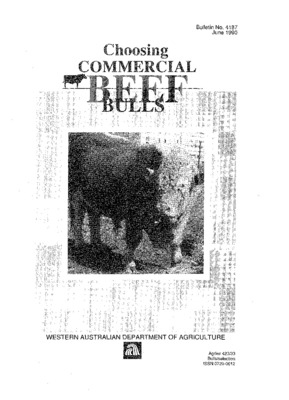
Bulletin No 4187 - Choosing commercial beef bulls
David Barker
This bulletin provides a method of placing realistic differences in value on young bulls offered for sale.
The prices paid for young bulls are often based on superficial appearance alone, and this has important financial implications for the purchaser. Different characteristics have either large or ... Read more
-
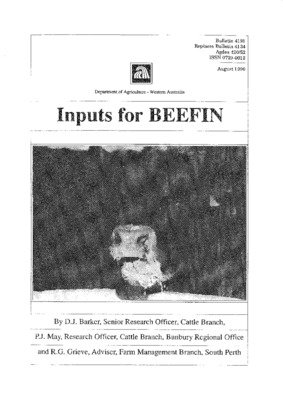
Bulletin No 4191 - Inputs for BEEFIN
D. J. Barker, P J. May, and R. G. Grieve
BEEFIN is a computer model (Barker et at. 1986) that calculates profit maximizing diets for finishing cattle to a specified carcass weight and fat thickness. It predicts cattle growth, feed conversion ratio, final liveweight, number of days on feed and amount of available feedstuffs to ... Read more
-
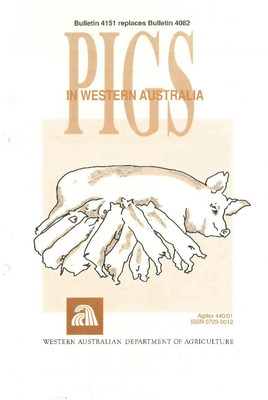
Bulletin No 4151 - Pigs in Western Australia
N W. Godfrey, B M. Goss, and H. G. Payne
Pig raising was originally a sideline on many Western Australian farms, being a convenient and profitable way to dispose of 'skim' milk on butterfat dairy farms and 'seconds' quality grain on wheat farms.
Most farmers ran pigs in large sties or small paddocks. With little ... Read more
-
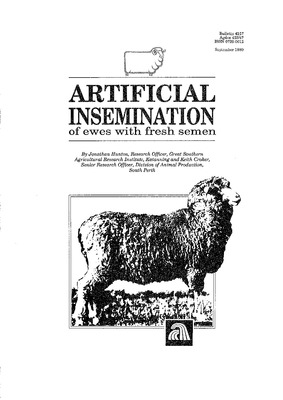
Artificial Insemination of ewes with fresh semen
Jonathon Hunton and Keith Kroker
This Bulletin gives a basic outline of the technique for artificial insemination (Al) of sheep. The topic is large and incorporates several areas of reproductive physiology which can only be given cursory treatment in this publication. Much of the information discussed is also applicable to ... Read more
-
Bulletin No 4158 - Western Australian beef industry - economic constraints and future market outlook
Alan Peggs
Since the mid 1970s there has been a substantial decline in cattle numbers in Western Australia. Most of this decline has occurred in the agricultural areas.
Much of the decline in cattle numbers can be attributed to low real cattle prices.
As a result of ... Read more
-
Bulletin 4152 - Sheep in Western Australia
R J. Suiter
Western Australia's sheep industry started in the early 1830s when the first flock-owners grazed their sheep on extensive areas of native vegetation, often by shepherding on unfenced country. Later, farm flocks built up as settlers cleared and fenced land for cultivation, and 'pastoral' or 'station' ... Read more
-
Beef in Western Australia
Western Australian Department of Agriculture
Western Australia's first European settlers introduced cattle for both milk and meat soon after a permanent colony was established in 1829. From this time, most Western Australian beef was produced as a side-line of t he dairy industry.
-
Plain wire fencing for pastoral lands
A McR Holm
The need to fence for efficient livestock control was recognised early in the history of the pastoral industry in Western Australia. Fence design, materials and layout have all undergone many changes since the 1880s. Modern fences have 4 or 5 strands of high tensile light ... Read more
-
Serradella, subterranean clover and medic research, Esperance, Western Australia
Michael D A Bolland
Strains of O. compressus which originate from Paros in southern Greece were the earliest flowering serradellas tested. They consistently produced amongst the highest seed yields, are relatively hard-seeded and are worthy of further investigation for deep sands and very acid soils in low rainfall areas. ... Read more
-
Survey of parasite control practices in sheep and cattle
J R. Edwards, R V R Gwynn, R A. Love, Richard Thomas Norris, G Dalton-Morgan, and Brown Besier
Farms in the Albany, Esperance, Jerramungup and Katanning districts were surveyed to determine parasite control strategies currently used, to evaluate the adoption of recommended control practices and to detect areas of ineffective parasite control. For cattle, the number of drenches given in the low rainfall ... Read more
-
Bulletin No 4101 - FLYSTRIKE - a manual for its prevention and control
N Monzu Dr
The sheep blowfly is still regarded as the Australian sheep industry's mostdamaging pest. Estimates of the cost to the industry, through production losses and prevention and control measures, exceed $ I 00 million in a year. This bulletin comprises the most relevant information available on:
... Read more -
Survey of post-weaning management, growth and mortality of Merino weaners
Richard Thomas Norris
Flock owner's excessive use of supplementary feed, especially of hay, lack of knowledge of nutritional requirements of weaners and failure to follow recommended methods of internal parasite control were the main areas of inefficient management. Management of the weaners as observed in the first year, ... Read more
-
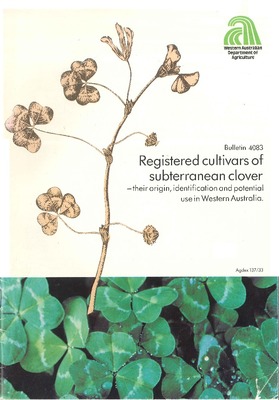
Registered cultivars of subterranean clover : their origin, identification and potential use in Western Australia.
W. J. Collins, B J. Quinlivan, and C M. Francis
The annual species subterranean clover (Trifolium subterraneum L.) is the most important pasture legume in Western Australia. In addition to providing nutrious feed for livestock, it is an important source of nitrogen for non-leguminous species in pastures for the State's ceral crops.
-
Toxic ferns of Western Australia
T E H Aplin, P Steele, and M C. Nottle
Botanical descriptions and notes on the distribution of six species of ferns are given. These plants contain the enzyme thiaminase, which may induce thiamin deficiency, or other constituents toxic to animals. The clinical signs of both thiamin deficiency and fern toxicity in affected livestock are ... Read more
Printing is not supported at the primary Gallery Thumbnail page. Please first navigate to a specific Image before printing.