


Files
Download Full Text (37.5 MB)
Description
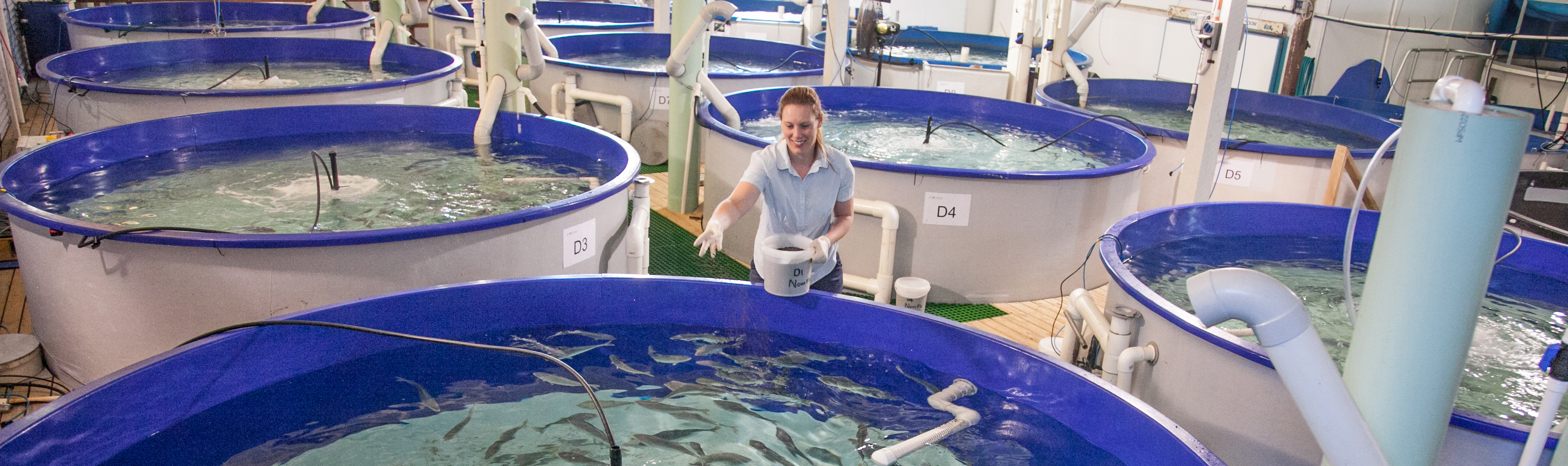
This study was undertaken to evaluate the nutrient excretion budgets for each of three key commercial diets when fed to barramundi (Lates calcarifer). The diets differed primarily in their energy density ranging from 21.3 MJ/kg DM to 23.0 MJ/kg DM, with the protein content of each diet being relatively constant at around 550 g/kg DM. The determination of the nutrient excretion budgets required the assessment of the digestibilities of key nutrients from each of the diets and also the specific retention of nutrients over a prolonged period. This necessitated two digestibility trials and a growth trial.
An examination was also made on the combined effects of changes in water temperature and fish size on the digestion of key nutrients by barramundi from each of three commercial feeds. Initially, faecal samples were collected from smaller fish at warmer water temperatures and later, larger fish at cooler water temperatures. Generally no specific effects were observed. The exception being with one of the diets (the high-energy diet; Diet 3); a consistent decrease in nutrient digestibility was observed between sample point and sample point 2, which was significant for phosphorus digestibility. Over a 50 day growth period, significant differences were also observed in the growth of the fish (initial weight of 556 + 21 g) fed each of the diets. Fish fed the two higher energy diets (Diet 2 and Diet 3) grew significantly better than those fed the lowest energy dense diet (Diet 1). It was shown that the poorer growth of fish fed Diet | was primarily a response to lower feed intake, but also to lower digestible nutrient content of this diet relative to the other two diets.
The discharge of various wastes and nutrient losses was examined and presented in a variety of ways. The expression of the various wastes and nutrient losses per tonne (t) of production was considered the most practical representation. On this basis the various wastes and nutrient losses were shown to vary considerably between the diets. Organic matter wastes varied from 274 kg DM't of live-weight production to 701 kg DM(/t of live-weight production. Of
this organic matter, N content ranged from 25 kg DM/t of live-weight production to 63 kg DMct of live-weight production and P ranged from 15 kg DM/t of live-weight production to 34 kg DM/t of live-weight production. Soluble excretion of N ranged from 54 kg DM't of live-weight production to 88 kg DMt of live-weight production and soluble P ranged from 1 kg DM/t of live-weight production to 18 kg DM/t of live-weight production. Solid wastes discharged were highest from fish fed the least energy dense diet (Diet 1) and lowest from fish fed the medium energy density diet (Diet 2). In contrast, soluble wastes discharged were lowest from fish fed least energy dense diet (Diet 1) and highest from fish fed the higher energy diets (Diet 2 and Diet 3). However, the low level of soluble waste discharged was consistent with the limited nutrient intake achieved by fish fed Diet 1 and the associated increased nutrient retention efficiencies.
The data from the study was also used to partially validate an existing bio-energetic model for barramundi. A high degree of homology was found between most data and the parameter estimates of the model. The model was then refined using data derived from this study and used to examine several theoretical constraints on feed design and management. Using modeling techniques it was shown that there is considerable capacity to manipulate both the composition and volume of waste excretion through diet design and diet management. Notably the release of soluble P, could in theory, be effectively eliminated by reducing digestible dietary P content to less than 6 g/kg. Similar reductions in soluble N release can also be achieved, but this would require a substantial reduction in dietary protein content that may compromise the protein and energy balance of the diet.
The project has also clearly highlighted the environmental advantages of using high-nutrient- dense (HND) diets with barramundi, particularly over the production size range of 500 g to 1000 g. Significant advantages were demonstrated in using HND diets, despite their being typically more expensive than LND diets, the improvements in feed use efficiency were shown to be more than adequate to compensate for this price difference. In addition, no differences in dress-out percentages (yield) or body fat content as were observed between fish fed either diet type. It was suggested that there may be scope for further improving these diets to address specific environmental limitations as they arise.
ISBN
1877098 31 0
ISSN
1446-5868
Publication Date
9-2003
Series Number
4
Publisher
Department of Fisheries, Western Australia
City
Perth
Keywords
Barramundi, Barramundi diets, Barramundi aquaculture water temperature, Faecal analysis, Bio-energetic model
Disciplines
Aquaculture and Fisheries | Biochemistry | Marine Biology | Nutrition | Physiology
Recommended Citation
Glencross, B,
Rutherford, N,
and
Hawkins, W.
(2003), Fisheries Research Contract Report No. 4 - Determining waste excretion parameters from barramundi aquaculture: Final Report for Aquaculture Development Fund of WA. Department of Fisheries, Western Australia, Perth. Book 4.
https://library.dpird.wa.gov.au/fr_frcr/6
This file is 37.5 MB. Files over 3MB may be slow to open. For best results, right-click and select "save as..."
Included in
Aquaculture and Fisheries Commons, Biochemistry Commons, Marine Biology Commons, Nutrition Commons, Physiology Commons



Comments
This contract report is not a formal refereed scientific publication and the Department will often publish sections of these reports in scientific journals, however, each report is reviewed internally for quality control purposes. This publication can be cited as Glencross, B., Rutherford, N. and Hawkins, W. 2003. Determining waste excretion parameters from barramundi aquaculture, Final Report for Aquaculture Development Fund of WA Fisheries Research Contract Report No. 4, Department of Fisheries, Western Australia, 48 pp.