

Bulletins 1 - 2999
This series was alternatively listed as Leaflets or Bulletins from 1 to 2199, then consistently named Bulletins from 2200.
-
Bulletin 104 - The Stickfast Flea
John G. C. Campbell
The insect which forms the subject of this Bulletin has raised great consternation in certain parts of this State by the trouble which it has caused amongst Poultry.
Fleas in general are notorious on account of the discomfort which they cause to man and animals, ... Read more
-
Bulletin 105 - Pedigree selection of seed at the Chapman and Merredin Experiment Farms
Geo L. Sutton
A Paper read before the Royal Society of the Royal Society of Western Australia, 12th October,1921.
"Pedigree" or "Pure Line" selection is that system of selection under which the choice is made, not. solely because of the attractive appearance of the plant, but because of ... Read more
-
Bulletin 106 - The Red-Legged Velvet Earth Mite
L. J. Newman
This pest is sometimes called in error the "Red Spider" or the 'Earth Flea."
It is neither a spider nor a flea, being a species of mite.
It belongs to the family of mites known as the Eupodidae and to the Genus Notophallus. Many of ... Read more
-
Bulletin 111 - Standard wheat varieties for the W. A. Wheat Belt
Geo L. Sutton and F. Vanzetti
Graded selected Pedigree seed is produced at the Chapman and Merredin Experiment Farms.
-
Bulletin 115 - The Value of windmills for pumping water in Western Australia
A. H. Scott
It is surprising to note the dearth of up-to-date reliable information dealing with actual results of modern windmills, under working conditions, though literature on thousands of other subjects less important can usually be obtained.
In this bulletin there is presented a complete and accurate record ... Read more
-
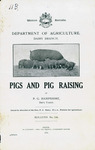
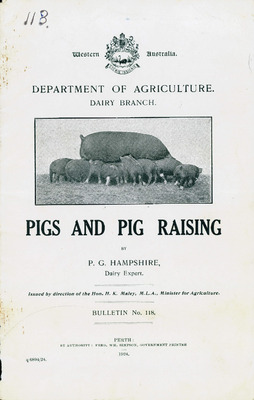
Bulletin 118 - Pigs and pig raising
P. G. Hampshire
The importance of the development of pig-raising as one of the primary industries of Western Australia cannot be too greatly stressed.
In Western Australia we have a deficiency in production of bacon and hams equal nearly £200.00 per annum. When this exceedingly profitable market has ... Read more
-
Bulletin 119 - Take-All of wheat and similar diseases of cereals
W. M. Carne and J. G.C. Campbell
This important disease, known also as Footrot, Blackleg, and Whiteheads, affects wheat principally, but also occurs on barley, rye, and certain grasses. In a very few instances it has been known to attack oats, but this is so rare that oats may be regarded for ... Read more
-
Bulletin 121 - Mildew, Septoria, Leaf spots and similar diseases of cereals
W. M. Carne and J. G. C. Campbell
Mildew attacks all the cereals as well as many grasses. but as in black stem rust the fungus has developed specialised races, one attacking wheat, another barley, another rye and so on, so that the form attacking wheat will not attack oats, etc
-
Bulletin 122 - Fruit-fly: Description and control
L. J. Newman
IT is a fundamental principle of Economic Entomology that, in order to successfully combat an insect, the life history of that insect must be worked out. A feature common to all insects is a series of stages involving distinct changes of form which succeed each ... Read more
-
Bulletin No 32 - Noxious weeds and poison plants
Department of Agriculture, Western Australia
Many settlers, new to this State, find some difficulty in distinguishing those vegetable pests which are classed as noxious weeds, the eradication of which is made compulsory under the Noxious Weeds Act of 1904.
In order to facilitate the ready recognition of the plants which ... Read more
-
Bulletin No 69 - The Poison plants of Western Australia
D. A. Herbert
Up to the present no publication dealing with the whole of the known i)01S0fl plaits of Western Australia has been written. This Bulletin contains the collected accounts of various authors and correspondents which have been published at different times and contains a large amount of ... Read more
-
Bulletin No 80 - Cultivation of Sugar Beet
Percy G. Wicken
The beet belongs to the Chenopodiaceae or Salsolaceae, an order of plants which include among them many of the native saltbushes. The sugar beet (Beta vuigaris crassa) is supposed to have been developed from the wild beet (Beta vulgaris maritima), which is indigenous to the ... Read more
-
Bulletin No 81 - The Improvement of pastures with notes on the Pasture Trefoils in Western Australia
E. A. Mann and D. A. Herbert
Agriculture can be roughly divided for practical purposes into two large divisions, those of animal husbandry and vegetable husbandry. It is with the former that this pamphlet is chiefly concerned and its object is to contribute, it possible, in some small measure towards the problem ... Read more
-
Bulletin No 84 - Tomatoes - Their culture in Western Australia
H. D. Larwood
The use of the tomato has become so general during recent years that it is now in great demand as one of the most popular and wholesome articles of diet.
The plant is heat-loving, but is easily destroyed by host. In temperate regions it is ... Read more
-
Leaflet No 1000 - Rate of milking with machines - Further results from Western Australian herds
R. A. Bettenay
IN an earlier article by this Department (Vol. XXVI No. 2 PP. 99-104) some introductory remarks were made on a study being conducted on the rate of milking by machine, and preliminary findings were recorded. The conclusion was reached that the rate of milking on ... Read more
-
Leaflet No 1001 - Aerial baiting for the control of the Little Plague Grasshopper (Austroicetes cruciata Sauss)
C. F. Jenkins
Aeroplanes have been tested for grasshopper control in many parts of the world during the last decade but the insecticides used have been in either dust or spray form.
The aerial distribution of bran bait is quite a recent development in overseas countries and was ... Read more
-
Leaflet no 1002 - Swine Paratyphoid (Salmonellosis necrotic enteritis)
C R. Toop
Paratyphoid is an infectious disease of pigs which is likely to make it appearance wherever pig raising is practised.
It may occur in an acute septicaemic form which is often rapidly fatal and accompanied by serious mortality and in a sub-acute or chronic form known ... Read more
-
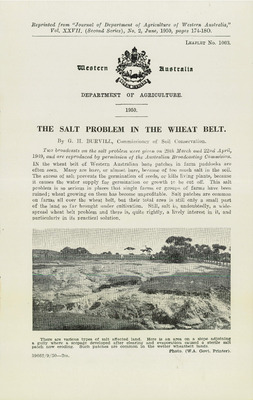
Leaflet No 1003 - The Salt problem in the wheat belt
G. H. Burvill
IN the wheat belt of Western Australian bare patches in farm paddocks are often seen. Many are bare, or almost bare, because of too much salt in the soil. The excess of salt prevents the germination of seeds, or kills living plants, because it causes ... Read more
-
Leaflet No 2024 - Mulesing and tail stripping. Proved measures for the control of crutch and tail strike in sheep
J Reilly
FOR many years, the losses from blowfly strike on the crutch and tail areas imposed a tremendous economic burden on the Merino sheep industry in Australia. Today, the modified Mules operation and the tail-strip treatment have provided a convincing answer to this menace. Breech wrinkles ... Read more
-
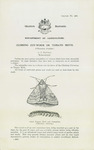
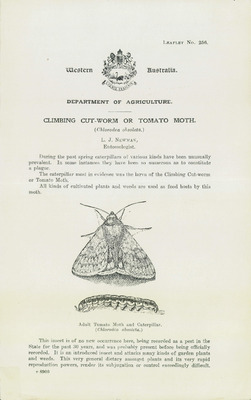
Leaflet No 256 - Climbing Cut-worm or Tomato Moth (Chlorodea obsoleta)
L. J. Newman
During the past spring caterpillars of various kinds have been unusually prevalent. In some instances they have been so numerous as to constitute a plague.
The caterpillar most in evidence was the larva of the Climbing Cut-worm or Tomato Moth.